After a Short Squeeze Do Stocks Fall Again
- Today's Market
The Massive Short Squeeze Could Cripple The Stock Market
Jan. 27, 2021 6:03 PM ET SPY, QQQ, DIA, SH, IWM, TZA, SSO, TNA, VOO, SDS, IVV, SPXU, TQQQ, UPRO, PSQ, SPXL, UWM, RSP, SPXS, SQQQ, QID, DOG, QLD, DXD, UDOW, SDOW, VFINX, URTY, EPS, TWM, SCHX, VV, RWM, DDM, SRTY, VTWO, QQEW, QQQE, FEX, ILCB, SPLX, EEH, EQL, QQXT, SPUU, IWL, SYE, SPXE, UDPIX, JHML, OTPIX, RYARX, SPXN, HUSV, RYRSX, SPDN, SPXT, SPXV 647 Comments 144 Likes

Summary
- The short squeeze we have been tracking has reached new heights.
- This could be a huge problem for the entire market.
- It could be the undoing of the recent rally.
- This idea was discussed in more depth with members of my private investing community, Reading The Markets. Get started today »
In case anyone hasn't noticed, there's a massive short-squeeze taking place right now, which has just finally caught the mainstream's attention. If one thing can put this stock market rally to a halt, this "event" could be that one thing that puts a halt to it. Short squeezes are incredibly painful, and one reason I employ a long-only, no leverage strategy myself. But my experience as a trader made me realize how painful it could be when being short, using leverage, and paying a rate for the right to be short could be.
Massive Short Squeeze
The short squeeze started weeks ago. The Refinitiv most shorted index has soared by 40% just this year, vs. the Nasdaq 100 ETF (QQQ) has risen about 4%. But this squeeze started long before this recent surge, going back to early November, with the index rising by more than 80%.
But the squeeze has now hit a fever pitch, which can create a lot of problems when shorts start taking significant losses. It could trickle into the market's broader parts as these short sellers need to start raising capital to cover margin calls and buy-ins. It means that the stocks that make up the S&P 500 could be at risk and sold to cover these losses or get portfolios back into balance. 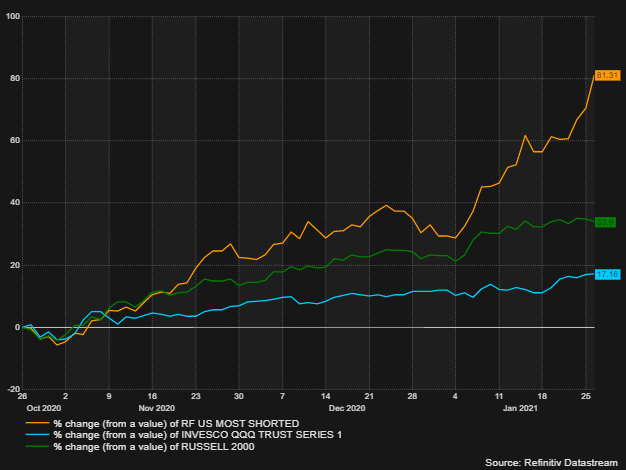
Mechanical Breakdown
The squeezes have been happening regularly when investors buy deep out of the money call options in some of these more speculative stocks. When this happens, the options market maker is forced to go long the stock to hedge against their short call position. If this speculation happens enough, and the market maker has to get long enough stock, it begins to push the stock price higher.
Until this point, the market maker, to account for the increasing amount of risk, has raised the options' pricing by pushing the implied volatility on the options. Rising implied volatility and a rising stock have been a good indicator of a gamma squeeze. This occurs when the stock price starts going higher, pushing the value of the calls higher, forcing the market maker to buy more of the stock to remain properly hedged.
If the stock goes high enough, holders that are long the stock may choose to start selling it. Now, because short sellers borrow shares from long holders, the stock loan department needs to replace the short sellers' borrowed shares when these long holders sell. If the stock is shorted enough, the cost to borrow shares may be more expensive to borrow, or the stock loan department may not be able to find new shares to borrow. This causes the short seller to either cover their short position or get bought in.
You can quickly see how this can spiral out of control. The short sellers begin to cover the stock - the price may begin to go up, which means the market maker needs to buy more shares, pushing the price higher.
However, presently, what started as a gamma squeeze turned into a short-squeeze, pushing some of these highly-shorted stocks to extraordinary heights. While one stock is not likely problematic for the market, it becomes problematic when this is happening in a countless number of stocks.
The short investors do so on margin, which means when they have to raise capital, they will likely do so by selling their long positions, which also are likely leveraged. When enough investors start being forced to cover enough short positions, this likely could weigh on the broader markets and cause serious issues.
The gamma-related squeezes we have been seeing and helping to fuel some of these epic short squeezes is why the most shorted-index has risen so dramatically in recent weeks. For the most, it has been telling us just how speculative the market has been getting and that the risk to the market was building.
Heighten Volatility State
It's also helping to explain why the VIX has remained so high and why it failed to return to its pre-pandemic lows despite the S&P 500 trading at an all-time high. Implied volatility levels all over the market are highly elevated. Because there's so much call buying taking place across the market, investors today pay a lot more for call options than they use, which is noted by a high skew.
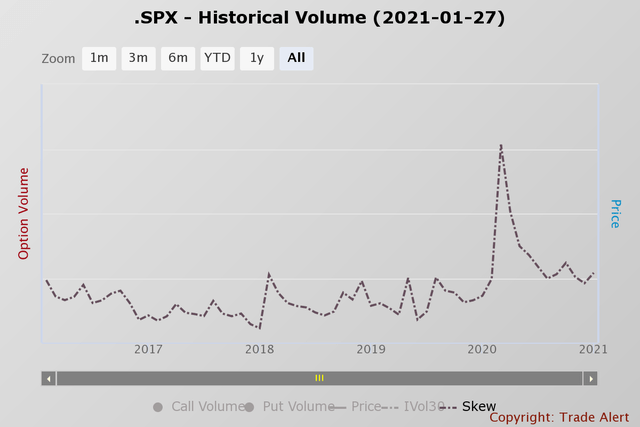
If the market dives because of the massive short squeeze taking place, the bottom line is that knowing what's happening is from a mechanical function, not the fundamental. But also remember that the market's mechanical function is what has put us at the elevated levels, to begin with.
Love this article? Then hit the follow button at the top of the story!
I have been at this for 25-years and spent 10 of those years as a buy-side equity trader for domestic and international markets. Now, I manage the Mott Capital Thematic Growth portfolio and run Reading The Markets. I use my knowledge as a trader, analyst, and portfolio manager to help update my readers every day on what is driving trading and where indexes, sectors, and stock may be heading, from both a short-term and long-term perspective.
To Find Out More Visit Our Home Page

This article was written by
Designed for investors looking for stock ideas and broader market trends.
Mott Capital Management writes short-to-medium-term focused articles on where stocks may go. We do not write articles on investing for the long-term. In a typical article, we will tell readers where Mike thinks a stock may go over a short period of time. This allows readers to understand why a stock may be rising or falling based on an analysis of fundamental, technical, and options trading activity.
We do not trade stocks for compliance purposes and to provide our readers with an unbiased opinion. Mike is a long-term growth investor and discloses if he holds a position in his long-only portfolio.
Disclosure: I/we have no positions in any stocks mentioned, and no plans to initiate any positions within the next 72 hours. I wrote this article myself, and it expresses my own opinions. I am not receiving compensation for it (other than from Seeking Alpha). I have no business relationship with any company whose stock is mentioned in this article.
Additional disclosure: Mott Capital Management, LLC is a registered investment adviser. Information presented is for educational purposes only and does not intend to make an offer or solicitation for the sale or purchase of any specific securities, investments, or investment strategies. Investments involve risk and, unless otherwise stated, are not guaranteed. Be sure to first consult with a qualified financial adviser and/or tax professional before implementing any strategy discussed herein. Upon request, the advisor will provide a list of all recommendations made during the past twelve months. Past performance is not indicative of future results.
Source: https://seekingalpha.com/article/4401453-massive-short-squeeze-cripple-stock-market
0 Response to "After a Short Squeeze Do Stocks Fall Again"
Post a Comment